
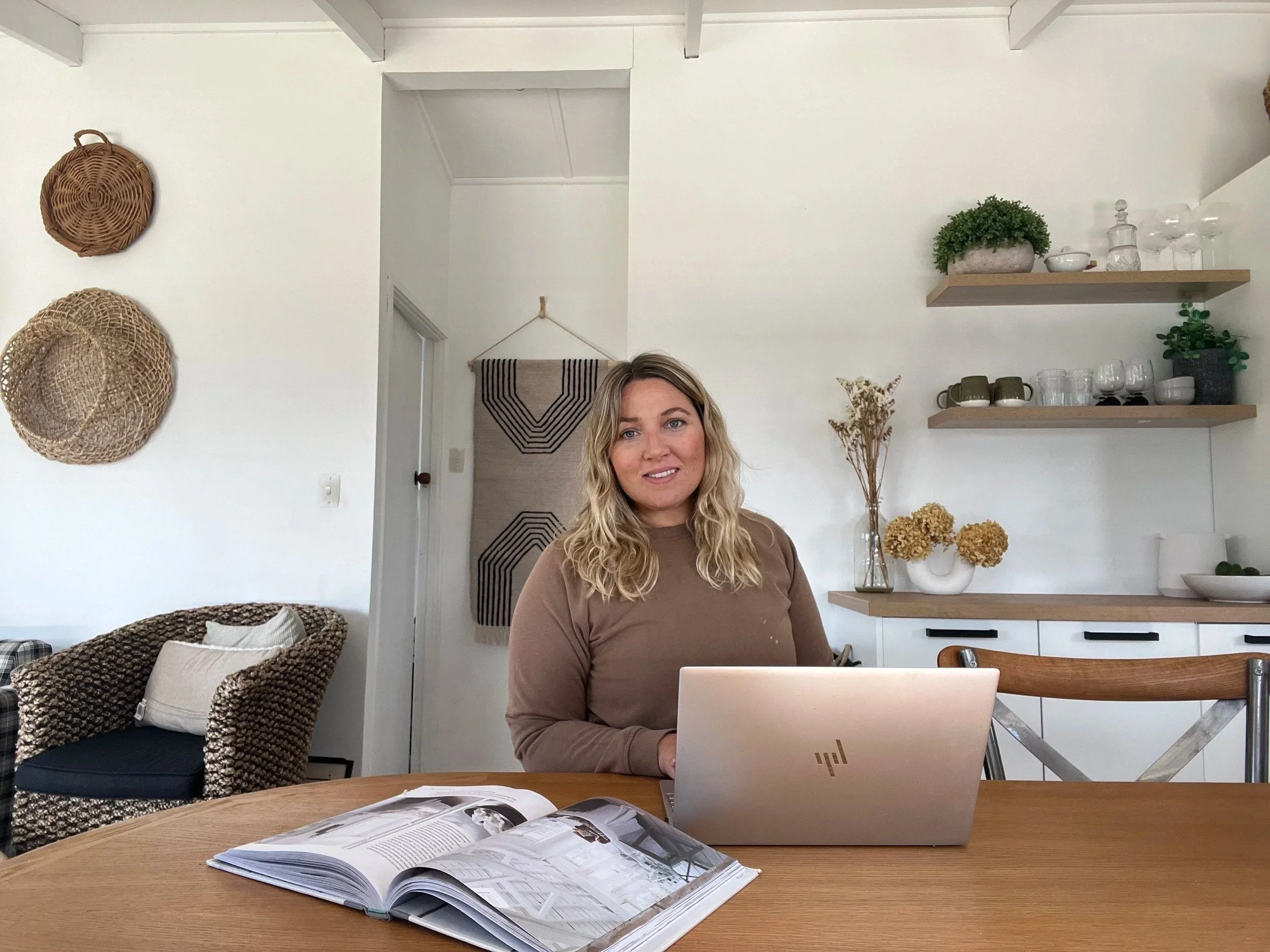
I'm Ryn Going. I live on a farm near Hamilton with my husband Jeff and our two kids, Hannah and Cameron. I have a corporate career that I enjoy by day and think about spaces almost all of the time.
This isn't a recent interest. When I was ten years old I talked my parents into letting me sponge-paint my bedroom blue; a shade that reminded me of water, where I felt most like myself. I saved my pocket money for a lava lamp to match. I rearranged that room constantly, standing back each time to feel whether it was right. I didn't have words for what I was doing. I just knew that the space I was in changed how I felt inside it.
That instinct never left. It just took me a while to understand why.
I studied psychology — specifically health psychology, the science of how we live well and spent time working with the University of Auckland's Health Psychology department before the corporate world pulled me in a different direction. Through my career I have never lost my quiet obsession with spaces I couldn't quite name or explain but the houses helped me figure it out.
My husband and I spent our early years together in old farm houses we couldn't renovate. Cold, dark, poorly laid out. I know now what was happening: my nervous system was responding to environments that offered no sense of safety, warmth, or belonging. At the time I just felt it. So I did what I could, I chose pieces carefully, flipped second-hand furniture, and thirteen years ago, desperate for a space that felt like ours we renovated a caravan together. Our first real project.
When we bought our farm nine years ago the house had to go. No light, no warmth, a layout that created friction at every turn, and the kids were getting sick. We knocked it down and built from scratch with sun, views to nature, and a layout that balanced open living with spaces to close off and breathe. Even with a six-month-old, we designed a parents' sanctuary at the other end of the house. That build taught me more about design psychology than anything I'd read.
Since then I've renovated the two workers' cottages on the farm, our pool house, a bach at Mangakino that belonged to my nana and that I couldn't bear to let go, and our beach house at Whangamata. Each one taught me something different about what makes a space feel like home.
What I've learned across all of it is this: the spaces we live in shape how we feel, how we think, and how we live. Not metaphorically literally. Light affects your nervous system. Clutter increases cognitive load. An object with history changes the psychological weight of a room. Warmth, texture, proportion, flow - these aren't aesthetic preferences. They're the conditions under which we either thrive or quietly struggle.
The Going Home is built on that understanding.
The Refound Collection is the physical expression of it; found and lightly restored objects, chosen for the feeling they bring to a space rather than the trend they follow. Each piece is the kind of thing I've always had in my own homes: old timber, worn ceramic, a mirror with a history. Collected, not curated.
And somewhere further down the road — a motel collection. Spaces designed from the ground up using everything I know about how environments shape the people in them. That dream has been with me for years. I'm building toward it deliberately, one piece at a time.
If you've ever walked into a room and exhaled without knowing why — or felt unsettled in a space that looked perfectly fine — you already understand what this is about.
Welcome. I'm glad you're here.
Ryn